Christie's
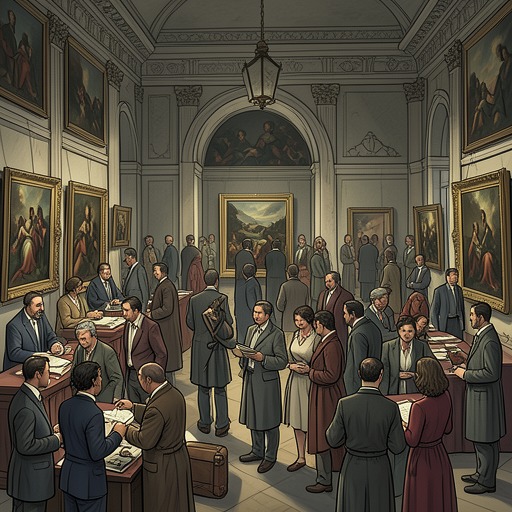
The Andy Warhol DiariesChristie's appears in Andy Warhol’s diary not as a fully described building but as a recurring setting for transactions that reveal how art and collecting are valued. The diary moves between catalogues, works offered for sale, a painting by Jean-Michel Basquiat, and a platinum flute whose final price overwhelms its buyer. Across these episodes, Christie's is both a practical marketplace and a stage on which private judgments become public prices, sometimes with consequences that continue well beyond the auction.
A recurring auction setting
On October 28, 1978, Warhol went to Christie's with Thomas Ammann, who was staying at Fred Hughes’s house, to obtain catalogues. Some of Warhol’s old drawings were being offered for sale. The diary records four catalogue prices—$6, $22, $8, and $10—alongside the more personal story of how Warhol had acquired an interest in American objects. The drawings had come from Bill Cecil, whose family was in the American antiques business. Warhol connected that family to his first cupboard, which by then stood in the Interview office holding pencils and rubber cement. An auction visit therefore brought together two kinds of history: drawings being assigned a sale context and an everyday piece of furniture that had passed into the working life of the magazine.
The cupboard’s modest office function contrasts with the appearance of Warhol’s drawings in auction catalogues. His recollection does not give their subject matter or estimate, but it does establish that work from his earlier life had become part of the market. The catalogue prices, carefully noted beside the account, also keep the scene grounded in practical costs rather than turning it into a general reflection on art. Christie's enters the diary as a place where the old and the saleable meet, while the objects connected to that market remain attached to personal memories and ordinary uses.
Basquiat and the pressure of sale
On October 31, 1984, the art dealer Bruno (art dealer) called with news from a Christie's auction: a large painting by Jean-Michel Basquiat had sold for $20,000. Warhol treated the result as evidence that Basquiat might become a major Black painter, but his response was not simply celebratory. He preferred Basquiat’s early work, which he saw as having been made through the act of painting itself, and worried that the need to produce saleable subjects could alter the work. In the same entry, he questioned how often an artist could repeat a marketable motif. The auction result thus marked both rising recognition and the possibility that commercial demand might narrow an artist’s choices.
Warhol’s concern was tied to a concrete recommendation: Basquiat should keep his early paintings in storage as a financial reserve rather than sell them all at once. He contrasted this advice with Bruno’s practice of buying up works and selling them gradually. Warhol pointed to the market for early works by Rauschenberg, as well as strong prices for Jasper Johns and Cy Twombly, while noting that James Rosenquist’s prices were only moderate despite his own high opinion of the painter. These comparisons show that the $20,000 result was not isolated in Warhol’s account. He used it to think about timing, an artist’s future security, and the way a body of work could be divided between immediate sale and later value.
The platinum flute auction
On October 18, 1986, Stuart Pivar took Warhol to Christie's to consider a platinum flute. Pivar had hoped to interest Warhol in a gold flute as well. A silver flute sold for $4,400; Warhol began bidding on the gold one, but his final bid of $22,000 was surpassed when it sold for $40,000. The platinum flute had been estimated at $40,000. Pivar had decided not to go above $120,000, yet he kept his paddle raised as the bidding climbed, and the instrument ultimately sold to him for $170,000. With tax and commission, Warhol put the cost at about $200,000.
The auction’s aftermath turned the purchase into a public misunderstanding. Pivar was in shock and could not explain to the reporters that the flute was his. People assumed Warhol had bought it and approached him with business cards and copies of Flutist magazine. Warhol gave different comic explanations for the supposed purchase, including that he wanted the World’s Fair emblem for his collection of plastic knives and forks, or that he planned to melt the flute down. He then got Pivar out of the auction room. Only afterward did they identify the competing bidder as a wealthy-looking man from New Hampshire; Warhol suggested Pivar invite him to one of his musical soirées and try to sell him something.
The flute also arrived with a story that shaped its appeal. A man had willed it to his mistress, but after his death his family could not accept that he had had a mistress, and the instrument was held up for ten years. Warhol described it as American. The detail gives the object a history beyond its material and price, while the bidding scene shows how quickly the auction converted that history into a startling financial commitment. The following day, Pivar was still dazed by the roughly $200,000 cost. Warhol accompanied him to an antiques center to look for another flute for $2, a deliberately sharp contrast that also registered Pivar’s immediate problem: how to pay for the one he had won.
The cost after the sale
By November 30, Pivar had not paid for the flute. When he and Warhol went to Christie's, Pivar hid so the staff would not see him; the auction house was calling him every day. He now regretted the purchase and wondered what he could recover if he tried to sell it. The change from the tense bidding to avoidance and doubt gives the episode its longer arc: the auction’s climax was not the end of the transaction, but the beginning of an obligation that followed Pivar into later weeks.
The diary places the flute episode beside Warhol and Pivar’s visit to an antiques and collectibles exposition, where Warhol found the objects repetitive and lacking in character. A World’s Fair service for eight or twelve was priced at $5,000; when told the price of a large spoon, Warhol joked that perhaps he should sell the dealer his own set instead. This was a different venue, but the comparison sharpens the diary’s recurring interest in objects, asking prices, and the gap between an item’s appeal to a collector and its burden as a purchase. Christie's matters in these entries because its sales make that gap visible: an old drawing enters a catalogue, Basquiat’s painting acquires a market figure, and Pivar’s prized flute becomes an expensive commitment that he cannot easily undo.